Place Viger Hotel - Haunted Hotel in Montréal, Quebec
1001 Rue St-Hubert, Montréal, QC H2L 3Y3, Canada
Paranormal Phenomena Reported
The Haunted History
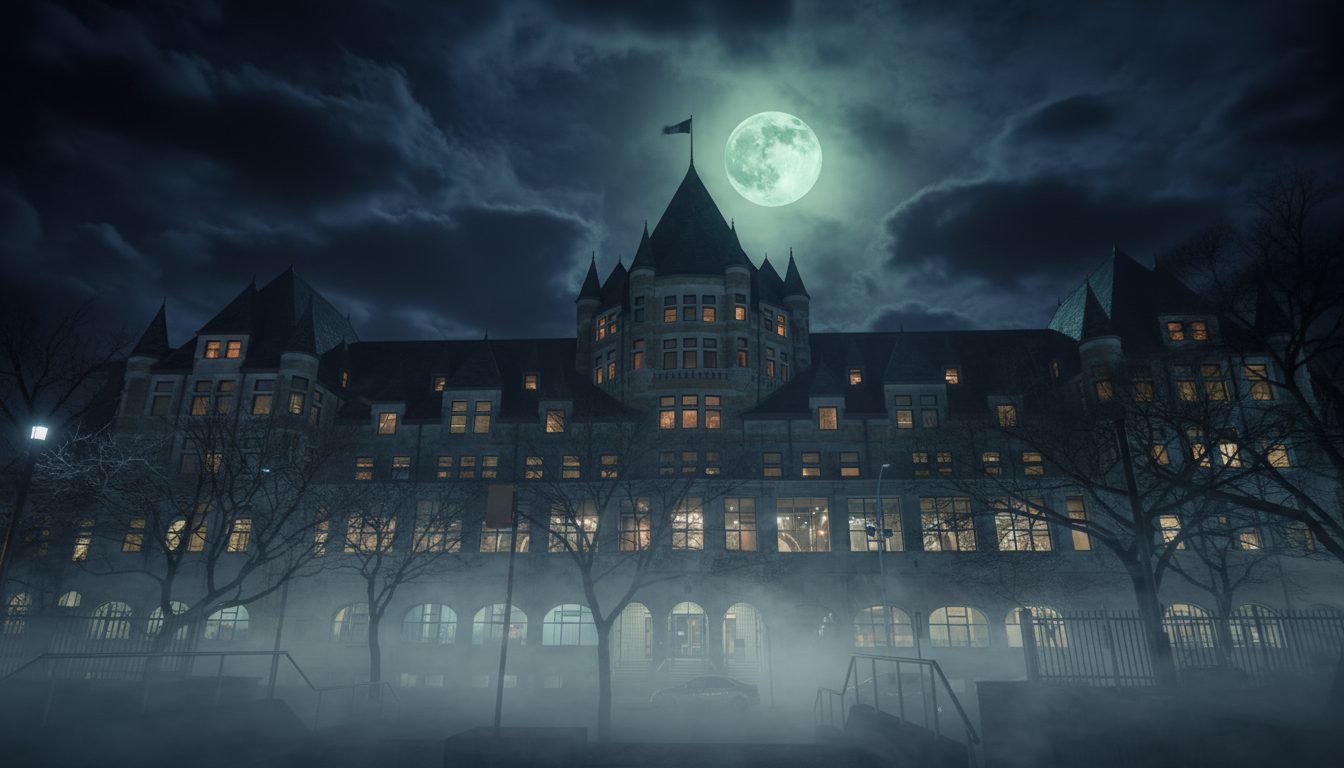
Constructed in 1898 and designed by renowned architect Bruce Price for the Canadian Pacific Railway, Place Viger was conceived as both a grandiose hotel and railway station. Built with Montreal gray stone and distinctive orange brick imported from Scotland, the structure showcases the Châteaux de la Loire style with pepperbox corner turrets, a pronounced conical roof, and decorative copper elements. Created to replace the outdated Dalhousie Station, Place Viger was perfectly positioned near Montreal's financial district, City Hall, the port, and courthouse, making it an ideal location for wealthy travelers and business people. Bruce Price, the architect, also designed other famously haunted Canadian hotels including the Banff Springs and Château Frontenac—his architectural legacy appears inextricably linked with paranormal activity. The hotel closed in 1935, a victim of the Great Depression, while Viger Station shuttered in 1951. The building was sold to the City of Montreal and renamed Édifice Jacques-Viger, serving as office and storage space for over 60 years. After changing hands multiple times, a $250 million mixed-use redevelopment was announced in May 2014, transforming it into an "urban campus" with a Hyatt Centric boutique hotel. Yet throughout these transformations, the building has maintained its haunted reputation, rooted in two major tragedies that occurred when it functioned as a working railway station. The most devastating tragedy occurred on New Year's Eve 1909, at precisely 11:27 p.m. The railway quay was packed with around 100 people gathered to bid farewell to friends and relatives departing for Quebec City on the final train of the year. Suddenly, a massive explosion scattered these people into the air, sending them crashing down in a chaotic heap of broken bodies. Over 20 people were seriously mangled and crippled. Children screamed for their parents amid the moans of pain and terror. The railway quay had split open along almost its entire length—a burst "Pintsch" gas pipe used to light railway carriages had leaked gas that filled the underside of the quay, covered by a thick layer of ice. The gas likely ignited from a carelessly tossed lit cigar. Among the victims, M. Diedonné Paquin, just 15 years old, was the youngest, his body twisted and mangled, transported to Montreal General Hospital in terrible condition. Mme. Patrick Guay, age 28, died from her injuries shortly after arriving at Royal Victoria Hospital. Captain Bellefleur, who witnessed the explosion, later said he couldn't define the feeling of the blast and wondered if he was still alive, fear keeping him immobile. Captain Bourgeois recalled an eerie coincidence: exactly nine years earlier on the same date and exact time, a Canadian Pacific train had beheaded a man just feet from where the explosion occurred—Bourgeois himself had picked up the victim's severed head, finding it nearly two feet from the tracks. The second major incident occurred on the evening of June 15, 1913, when a railcar loaded with 80,000 gallons of coal tar broke away from a train in the Mile End Railyards. The car rolled down the slope toward the river, racing uncontrolled toward Viger Train Station. It jumped the buffer, forged across the concrete concourse, and slammed into the waiting room, tipping over and spewing thousands of gallons of coal tar. The tarry mess filled the waiting room and splattered to the ceiling. Three people were injured, including Alfred Gadoury, who was seriously hurt and taken to Notre-Dame Hospital covered in coal tar. The building also witnessed a robbery in the early hours of April 3, 1935, shortly before the hotel closed permanently, when a man passed a note demanding money at the ticket counter while appearing to have a revolver in his pocket. The clerk handed over $200 and the thief fled, never to be caught. Today, the building is pervaded by overwhelming sadness and negative energy. Disembodied screaming of children crying for their parents echoes through the empty structure—believed to be residual haunting from the 1909 explosion, when over 100 people were scattered and children screamed for their mothers and fathers. Tourist Amy C, visiting from Washington DC, posted a Yelp review on July 31, 2011, describing her encounter: drawn to the building by its green rooftop and interesting architecture, as she approached she "felt a very strong negative energy about the place" and "immediately knew the place was haunted." Most disturbingly, she reported: "I heard children crying for their mothers and the sadness engulfed me. I felt a tightness in my chest so I practically ran back across the street." She noticed broken glass on the sidewalk near Place Viger's front, and as soon as she crossed the street, felt better. Immediately after her experience, a car collision occurred directly in front of Place Viger. Despite this disturbing encounter, she gave the building 4 out of 5 stars in her review, fascinated by its haunted history. Whether 15-year-old Diedonné Paquin survived his terrible injuries, or whether children on the train lost parents in the explosion, is unknown—but their voices continue crying out over a century later, making Place Viger one of Montreal's most tragically haunted locations.
Share Your Paranormal Experience
Had a ghostly encounter at Place Viger Hotel? Tell us about it.